
Until March 19, 2026, a survey regarding the expectations and wishes of C3NMH staff was available through the Center. The survey will be analyzed in the coming weeks, and the results will be published. Some comments indicate that the Center’s operations are not yet widely understood. Therefore, we have endeavored to summarize some facts about the C3NMH:
The abbreviation stands for Comprehensive Center for Clinical Neurosciences and Mental Health.
The German translation—Zentrum für Klinische Neurowissenschaften und Mentale Gesundheit—is not used.
Since early 2015, the Vienna General Hospital (AKH) has been jointly managed by the federal government (Medical University of Vienna) and the City of Vienna (the legal entity responsible for the AKH) as a result of the University Medicine Vienna 2020 project.
One subproject of University Medicine 2020 was the establishment of centers with the assistance of a joint steering group for center organization (SG-ZO) comprising the Medical University of Vienna and the Vienna General Hospital (AKH).
The Comprehensive Center for Clinical Neurosciences and Mental Health (C3NMH) was designated as one of these centers.
The inaugural meeting of the C3NMH took place in April 2022.
The scope of activities covers clinical neuroscience and mental health. The focus is on personalized approaches to the diagnosis, treatment, and prevention of neurological and mental health disorders.
The C3NMH consists of a core unit and other participating institutions.
The core unit of the C3NMH comprises eight clinics/departments in the fields of neurology and psychiatry. The heads of these departments form the C3NMH’s steering committee.
Core Unit of the C3NMH
Department of Neurology
Division of Neuropathology and Neurochemistry
Department of Neurosurgery
Division of General Psychiatry
Division of Social Psychiatry
Department of Child and Adolescent Psychiatry
Department of Psychoanalysis and Psychotherapy
Division of Neuroradiology and Musculoskeletal Radiology
Including all involved professional groups: physicians, scientists, (neuro)psychologists, physical therapists, speech therapists, medical assistants, medical technologists, radiology technologists, social workers, clinical administration
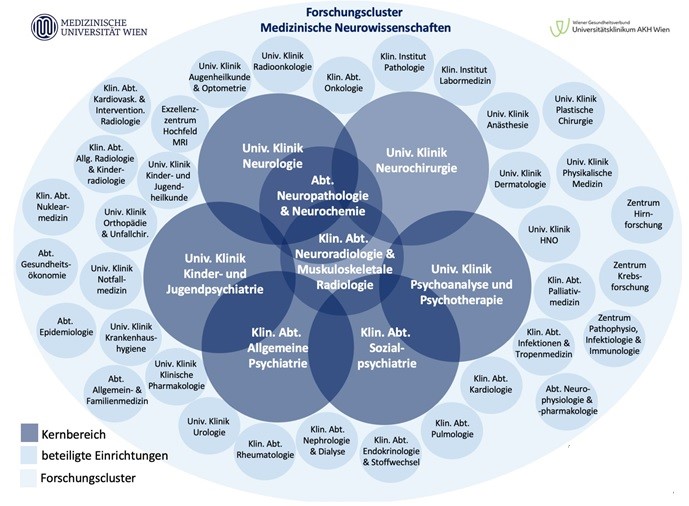
Other clinics, departments, and facilities are affiliated with the C3NMH through their expertise and are represented in the Center Conference, the center’s “parliament.
Until May 31, 2026, the steering committee consists of:
Prof. Stephan Doering (Chair)
Prof. Karl Rössler (Vice Chair)
Prof. Thomas Berger
Prof. Dan Rujescu
Effective June 1, 2026, the new steering committee will take over:
Prof. Romana Höftberger (Chair)
Assoc. Prof. Nilufar Mossaheb (Vice Chair)
Prof. Gregor Kasprian
Prof. Paul Plener
The center coordinator is employed by the C3NMH and assists the management with the day-to-day operations of the C3NMH.
On February 2, 2026, Brendon Stubbs assumed a §99 (5) assistant professorship in Mental and Brain Health under the tenure-track model at the Medical University of Vienna. In this role, he will lead and support interdisciplinary research at the Comprehensive Center for Clinical Neurosciences and Mental Health (C3NMH). Brendon Stubbs is based in the Clinical Department of Social Psychiatry.
The cross-organizational and cross-departmental C3NMH is intended to permanently strengthen and institutionally anchor clinical, scientific, and educational collaboration among the participating neuroscience institutions.
The goal is to continuously improve care for patients with neurological and psychiatric disorders, as well as to consolidate and expand recognition as a leading medical research and teaching institution in Austria and Central Europe.
The C3NMH is intended to be the first choice for referring physicians, patients, and research institutions.
The following tasks in the areas of research, diagnostics, therapy, and teaching are intended to ensure, in detail, the achievement and continuous development of further goals of the C3NMH. In particular, these tasks will be coordinated and defined in the goal-setting meetings with the Rectorate and the Management Board:
- The C3NMH identifies, consolidates, promotes, structures, systematizes, coordinates, and networks clinical, scientific, and educational collaboration in the field of clinical neuroscience in the broadest sense, as described in the preamble, particularly when such collaboration requires or facilitates cross-departmental cooperation.
- The C3NMH coordinates and focuses the center’s shared resources with the aim of optimizing their use.
- The C3NMH is committed to developing interdisciplinary diagnostic and interprofessional therapeutic personalized standards in the form of evidence-based guidelines (standard operating procedures/SOPs) for the care of patients in the joint focus areas at Vienna General Hospital (AKH) – Medical University of Vienna (MedUni) and to continuously updating them. The C3NMH coordinates all related quality management activities, particularly those aimed at the continuous improvement of patient safety and data protection.
- The C3NMH implements procedures for structured information exchange within the center, particularly within the framework of interdisciplinary boards.
- The C3NMH participates in and develops collaborative initiatives for pre- and post-hospital care of neurological, neurosurgical, and psychiatric patients within the Vienna healthcare region.
- The C3NMH participates in and develops projects and measures aimed at preventing neurological and mental health disorders.
- The C3NMH promotes and drives the development of clinical sub-specialties with unique selling points into regional and national centers of excellence.
- The C3NMH initiates and supports institutional structures and projects related to multidisciplinary neuroscience and mental health research, teaching, and clinical care for patients. This specifically includes the (further) development of focus-specific clinical and scientific databases and registries.
- The C3NMH promotes intensive and systematic scientific collaboration with the medical-theoretical research institutions of the Medical Neuroscience Cluster, particularly with the Center for Brain Research.
- The C3NMH supports the implementation of joint research projects in general and EU projects in particular.
- The C3NMH promotes the strengthening of relationships and collaborations with other domestic and international research institutions and industry partners to further expand clinical neuroscience, mental health, and translational research activities.
- The C3NMH works closely with affiliated institutions in the areas of clinical trials and patient care, including the management of patient flows. To this end, a network of cooperating hospitals, private practitioners, and self-help groups is being established to increase efficiency.
- Within the scope of what is possible, the C3NMH allocates budget funds—in compliance with the highest standards of transparency—to support (translational) scientific projects, to further develop and communicate research results, and to cover related travel expenses.
- The C3NMH contributes to the design of courses and course content in the field of (clinical) neuroscience and mental health, including undergraduate and graduate education, continuing medical education, and, more broadly, the training and continuing education of all professional groups involved in the care of patients within the C3NMH’s defined areas of focus.
- The C3NMH participates in and develops additional PhD programs to ensure the continuous supply and retention of young researchers.
- The C3NMH promotes the systematic establishment of programs for national and international “knowledge transfer.”
- The C3NMH also sees its role as establishing internal systematic communication tools, internal and external clinical and scientific continuing education programs, as well as strategies for corporate public communication, including informational events and advocacy.
- The C3NMH contributes to outcome research in the areas of interdisciplinary clinical, scientific, and educational priorities.
- The C3NMH regularly evaluates the achievement of goals in the areas of service volume development, quality indicators, research activities, and patient satisfaction.
We always welcome your ideas, which can be directed to the center coordinator.
Comprehensive Center for Clinical Neurosciences and Mental Health
Medical University of Vienna
Währinger Gürtel 18–20, 1090 Wien